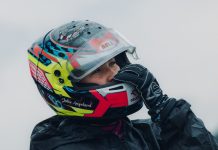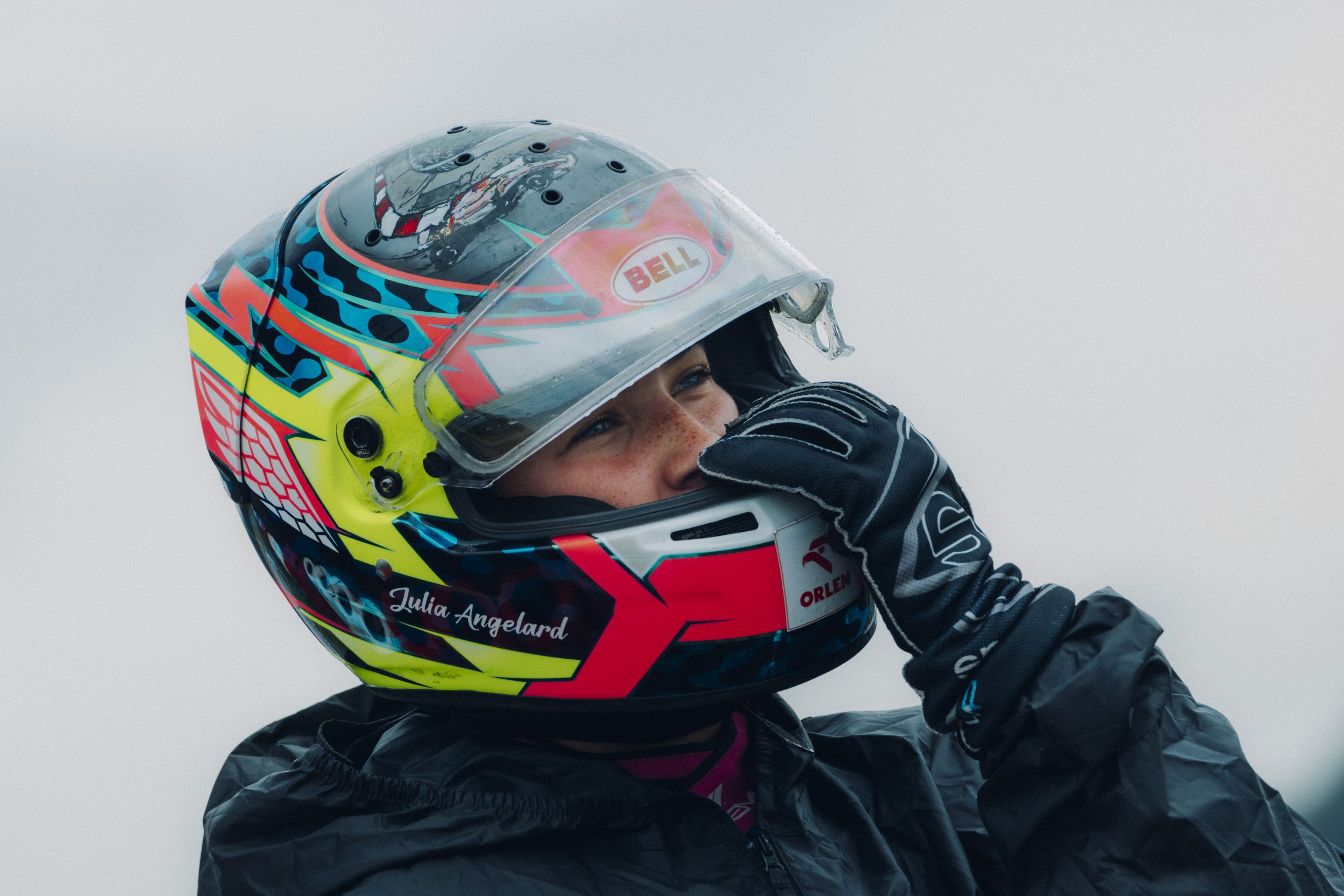
Nineteen thousandths of a second. That is the margin by which Julia Angelard won at Poznań, in the second round of the 2026 Polish Karting Championship, setting the fastest lap of the weekend on the very last lap of the last race, tyres already worn. It was enough to make her the first woman to win that event in fifteen years. There is one detail about her life, though, that not even those who follow her closely know: she has a twin brother.
At 14, Polish-born and now based in Italy, Julia Angelard races in OK Junior and juggles seven different programmes in parallel, among them the Polish Championship, the FIA Karting European Championship, the Richard Mille Young Talent Academy, More Than Equal and the newly announced F1 Academy Discover Your Drive selection. She joined Giovanni Minardi‘s stable in 2024, and he now oversees her path toward the jump to single-seaters. In the first seven months of 2026 alone she logged 107 days on track and 62 flights, without ever missing school: this year she graduated with distinction.
A kart with RK stickers
Julia doesn’t really remember that first day on a kart, at four years old. “I would like to answer with something interesting, but I was four years old and I simply don’t remember,” she admits, with disarming honesty. What she does know, because she’s been told, is that whenever her older brother Maks was at the track, the whole family went along: her, her other brother Aleks, and their parents. One day she and Aleks got the chance to sit in a small kart and try driving it for the first time. They both liked it, so their parents bought the family’s first kart, one with RK-branded stickers that Julia still remembers well. Then the two brothers’ paths went separate ways: “At one point Aleks decided he didn’t like it any more. I loved it, and I had so much fun that I looked for any opportunity to drive.”
That family kart, ten years on, has grown into an organisational machine holding together seven programmes spread across Europe. At first it was mostly her father’s job: “At the beginning, my parents decided that karting and racing would be my father’s duty.” Then things became more intense, partly because in the meantime Maks turned professional in the Michelin Le Mans Cup, in the LMP3 class, and the workload was split between both parents: her father keeps a shared family calendar online, her mother handles flights, her father hotels and car rentals. It’s not always enough: “Sometimes it’s hard to remember everything, even just having the right suits and overalls, because with all the programmes and academies I have a different overall for Champions of the Future Academy, which runs alongside F1 Academy Discover Your Drive, a different one for FIA European and WSK races, and another for the Polish Championship. I also have different clothing and accessories for More Than Equal activities.” When she’s home, though, karting is still a game between siblings: “I still often go to rental karts with my brothers.”
Something, in the middle of all this, has been left behind. Until two years ago Julia practised acrobatic gymnastics, a passion running alongside motorsport, but her schedule eventually left no room for both: “Unfortunately, around two years ago I had to quit, because we couldn’t fit it into my busy schedule any more. I miss it sometimes.”
The fastest lap on the last lap
Of the seven programmes Julia follows, the Polish Championship holds a place apart: it isn’t the sporting priority of her season, but the stage where she races for sponsor ORLEN, which, being Polish, wants to see its drivers competing at home too. And it was right there, at Poznań, that the sharpest moment of her 2026 arrived, in the least predictable way.
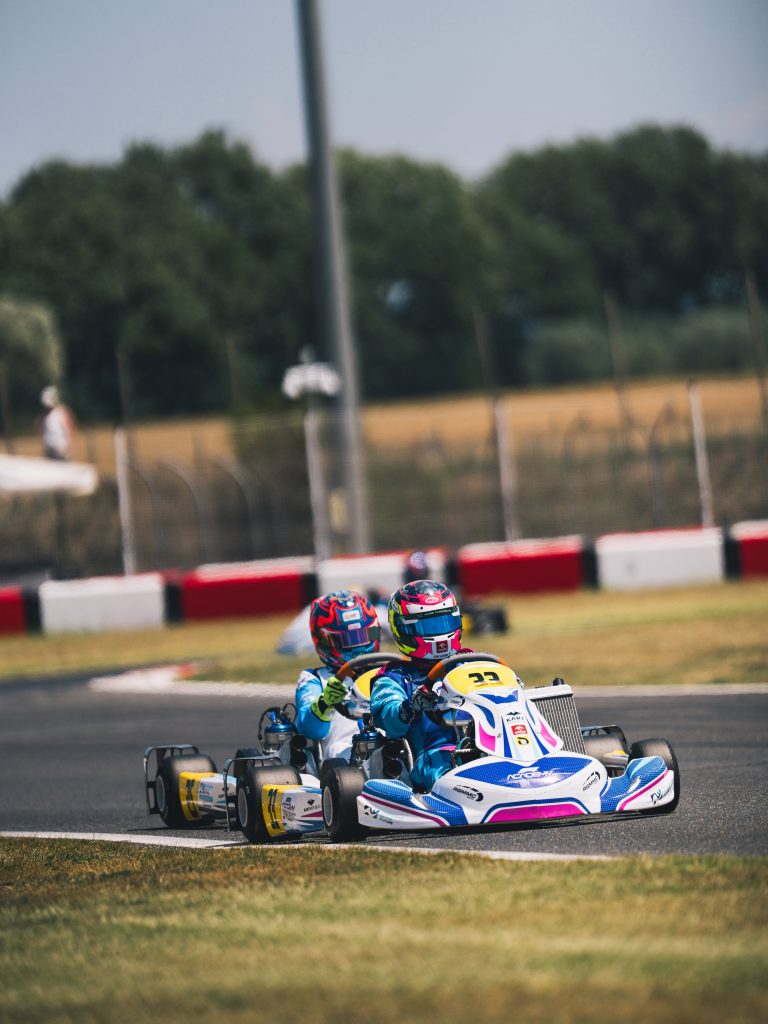
The team had come into the weekend with no prior testing, having also missed a day of official practice because Julia was flying back from a camp in the UK. “Of course I wanted to perform as well as possible, but I didn’t have any particular expectations,” she says. “During the race I wasn’t thinking about points: I knew I had good pace and a good position for the podium, and I just wanted to finish the best I could.” The Polish circuit has a very long straight, where the aerodynamic tow behind the driver ahead counts for a lot. In the last race of the weekend Julia was running second, and caught the right moment to use it. The rest was written by the clock, on the last lap of the last race, tyres already worn: “I won by one point, the point for the fastest lap, which I set on the very last lap — the fastest lap of the whole weekend, even with the tyres already worn out. After a hard weekend, it felt great to show how quick I am, and to be the first girl to win in Poland in fifteen years.”
A broken axle and the track of her dreams
On the international front, 2026 in the Champions of the Future Academy hasn’t produced a podium yet: Julia has finished fourth three times, most recently at Viterbo. She talks about it with self-irony rather than drama: “It’s racing, it’s sport. Sometimes you just need a little bit of luck. For me it’s important that I can drive fast and fight for top positions, so I hope I’ll have more luck next time.”
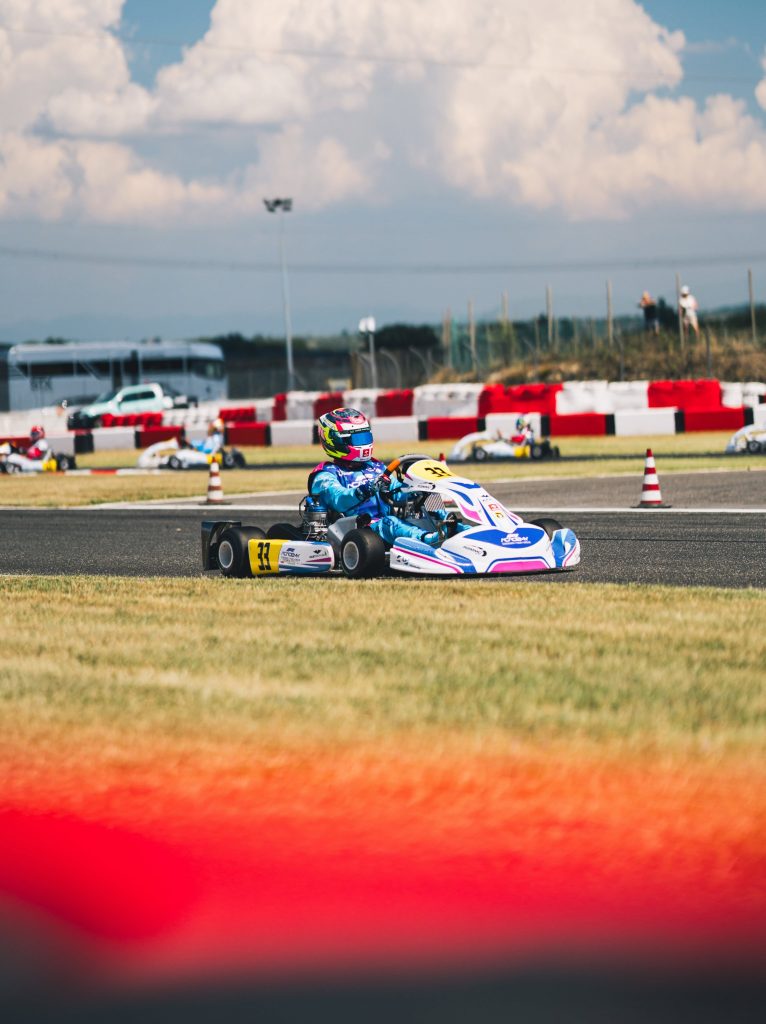
A much heavier disappointment had already tested her a few months earlier. In the Champions of the Future Academy final in the UAE, at the end of 2025, after an already very long season, a broken rear axle took away a result that had seemed within reach. “It’s never easy to take such a disappointing end to the season, especially when it’s out of your control,” Julia says. “Luckily it was just equipment damage, not a serious accident for me or any other driver. It’s racing. I’ve had many races since then.”
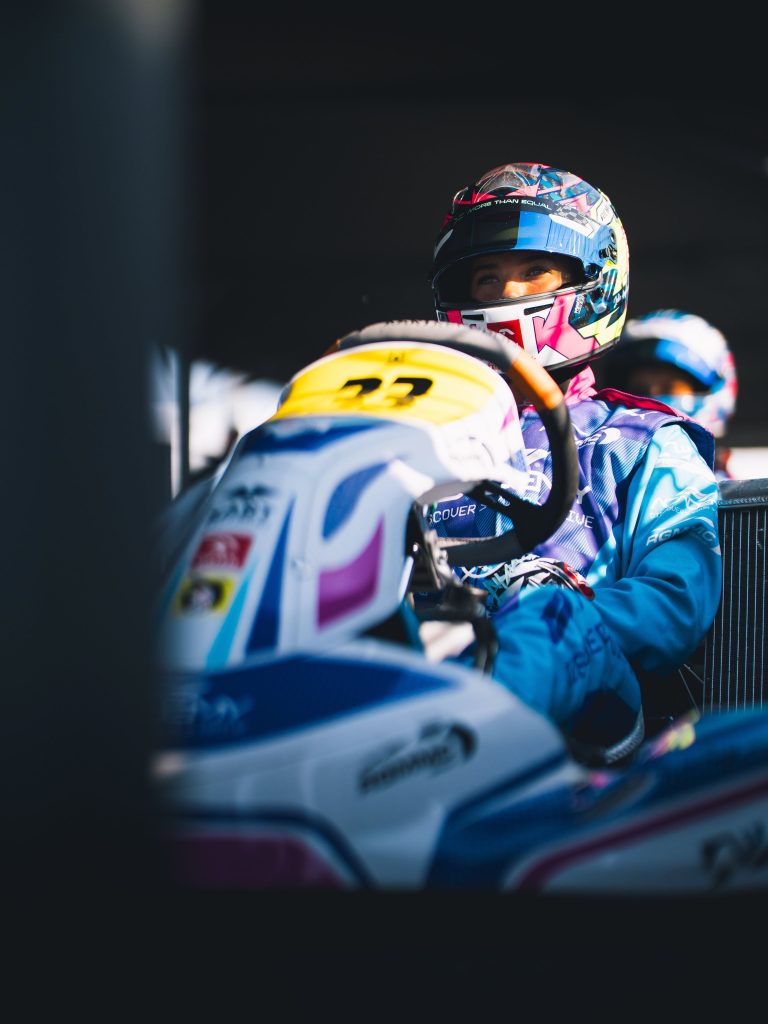
In November the Champions of the Future Academy season will close at Franciacorta, the track she considers home. “I like how ‘flowy’ the corners are. With the right balance you can smoothly fly through the corners. Some of them are quite tight, but some are flat-out corners you take at high speed.”
Two programmes, one goal
If karting remains her day-to-day battleground, Julia’s 2026 is being decided mostly elsewhere, in the parallel race to catch the eye of the programmes that scout the future stars of women’s motorsport. That road began in 2024, when she became the only Polish driver among the twenty finalists of the Iron Dames Young Talents shootout. The memory of that call is still vivid: “I remember being at a Rok Cup Italy race in Jesolo, when my father told me that someone from Iron Dames had contacted us. It was a great but also strange feeling, that someone had noticed me and invited me to the shootout.” That experience, she says, was designed to give something to every participant, not only to the eventual winner: “The intention of the shootout wasn’t only to select the future Iron Dame but also to give a lot of training to all the girls, to help them become better drivers. It also gave me the opportunity to meet other female drivers I’m still friends with, and still race against.”
Two years on, that road has taken her into two programmes sharing the same declared goal: developing the first female Formula 1 World Champion. First More Than Equal, then, with the selection announced in February 2026, F1 Academy Discover Your Drive — the programme that picks just nine drivers each year, three per category (Mini, OK-N Junior, OK-N Senior), and that chose Julia as one of the three in the Junior category. She speaks of it as a double recognition: “It means a lot to me to be part of both programmes, especially at this stage of my career when I’m planning the transition from karting into cars. Having been selected by two programmes focused on developing female racing talent gives me confidence that I’m progressing in the right direction.” More Than Equal, she adds, works on the long term, with “on-track coaching, physical preparation and mindset, all underpinned by data and research,” while F1 Academy Discover Your Drive opens another window onto the F1 Academy pathway itself, as well as building her visibility and connections with the programme’s sponsors.
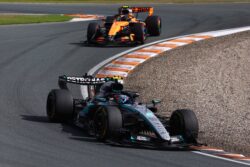
That visibility had a concrete moment in August 2026: both programmes invited her to the Formula 1 and F1 Academy race weekend at Zandvoort. “It was the first time in my life I saw both paddocks, had the chance to meet and talk to drivers, and see the McLaren F1 garage. It was just before the sprint race, so it was very busy, with the whole team working on Oscar and Lando’s cars.” And asked which, among the many projects she follows, she considers most decisive for her development, her answer doesn’t hesitate: “They’re all great, and they all serve a different purpose. With the budgets you need in motorsport, I need all the support I can get. But for my personal development, at this stage of my career, I think More Than Equal gives me the most support: there’s a whole group of professionals working on a programme dedicated to me as a driver and to my preparation for the switch to cars.”
From karts to gears
That switch, in practical terms, has already begun. In June 2026, with More Than Equal, Julia drove a Ginetta and a Formula 4 single-seater for the first time, and the jump in sensations from a kart was immediate: “A car is completely different from a kart, with all the G-forces. You have to manage the gears so the engine always has enough power. Also, the brake and corner balance of the car is much more complicated than in a kart.” Between the two, she picks the tougher one without hesitation: “I liked both the Ginetta and the Formula 4 a lot, but the Ginetta is more difficult.”
On the actual jump to single-seaters, Julia doesn’t commit herself. Not because she’s dodging the question: the Richard Mille Young Talent Academy, the karting programme she belongs to, isn’t directly linked to the Formula 4 Academy run by the same foundation, whose selection goes through a separate shootout, and plans for 2027 aren’t settled yet. “I can’t talk at the moment about plans for next year and the years after that, but my parents and management are already working on it. Depending on the budget we’ll have, we have a Plan A, a Plan B and a Plan C. I hope we can make Plan A happen — it’s very intense, but I’m very excited about it. It would help me grow a lot as a driver.”
Alone on the grid, proudly Polish
Even in 2026, Julia is still almost always the only girl, or one of very few, on the grid. It doesn’t seem to be something that weighs on her on track: “When you put the helmet on, it doesn’t matter if you’re a girl or a boy. You just have to give your best and get the best possible result,” she says, before adding that off track things are different: “We race each other on the track, but off it I have a lot of good friends among the drivers in the paddock.”
Part of that representation also comes through the colours she carries in the Polish Championship, where she races for sponsor ORLEN: a bond that, she’s keen to point out, goes beyond that single series. “ORLEN’s support isn’t limited to the Polish Championship. The Academy and the support are tied to the driver, not to any team, and they’re planned for the whole season.” Behind it lies a clear upbringing: “I was raised by my parents as a Polish patriot, so I feel proud that I can represent my country all over the world and race in the white and red colours. It’s also great to see more and more Polish drivers and other athletes succeeding internationally.”
“I want to beat Schumacher and Vettel”
Behind the packed schedule, Julia’s ambition remains stated without much beating around the bush: to beat her idols, Michael Schumacher and Sebastian Vettel. Asked where such an explicit goal comes from, at 14, she answers calmly: “My goal is to be the best driver I can be. I’m still young, and I don’t know where this journey will take me or how far I can get. This past year I’ve had a lot of support from everyone I’ve worked with, including the whole More Than Equal team, who are helping me develop. Of course, I’d like to become an F1 driver, but right now that’s close to a miracle for a female driver. Still, I want to go as far as I possibly can on this journey.” Then she adds the line that perhaps best sums up her approach: “For now, I prefer to focus on the things I can do something about. The things that are beyond my control are handled by my parents and my management.”
The teammate she’d choose to share a garage with for a full race weekend, from any driver of any era? Max Verstappen, no hesitation. And asked what her followers would never guess about her, Julia first talks about the not-so-simple balance between public and private life: “My team and I try to balance what we post on social media. They’d like to show more of my personal life, some behind-the-scenes things, more lifestyle details. We understand that these days social media is a very powerful tool for building visibility and creating opportunities with partners and sponsors. But at the same time, we want to strike a balance and keep as much privacy as possible. Some things stay just for the friends I actually spend time with.” Then she adds the detail almost nobody knows: “But one thing almost nobody knows is that I have a twin brother, Aleks. He’s five minutes older than me, which he likes to bring up as an argument.”
Aleks, too, in the end, is part of the same story: that of a family that has organised itself, weekend after weekend, to give Julia the space to race. Schumacher and Vettel remain the declared target. The rest, as she says herself, isn’t hers to worry about: her parents and her management take care of it.